

Rubber molding production is moving toward tighter process control, wider product variation, and more flexible equipment planning. Injection unit sizing matters because the unit must match material volume, mold design, part geometry, and expected production range. A poor match can limit process adjustment or create unnecessary material residence time.
For manufacturers planning future capacity, sizing should be treated as an engineering decision rather than a single machine specification. Shot volume is important, but pressure, material behavior, cavity count, runner volume, and future mold changes also need to be considered.
Why Injection Capacity Must Match the Mold
The injection unit must supply enough material for the molded part, runners, sprues, and a practical cushion. If capacity is too small, the unit may work close to its limit on every cycle. This leaves less room for process adjustment when material viscosity or mold conditions change.
Oversizing can create a different problem. If only a small part of the available capacity is used, rubber may remain in the barrel longer than necessary. Since rubber compounds are sensitive to heat history and residence time, excessive capacity can make processing less consistent.
When comparing a rubber injection molding machine, buyers should therefore look beyond nominal shot size. Part volume, compound density, runner design, cavity count, and expected process allowance all affect the real injection requirement.
Shot Size Does Not Work Alone
Injection pressure is closely linked with shot size. Thin sections, long flow paths, and detailed cavities can create more resistance than thick, simple parts. The injection unit must provide a suitable operating range for the selected compound and mold.
Fill time also deserves attention. Production does not always benefit from using the highest available injection speed. Controlled filling can be more useful when the process needs stable pressure development or when the mold contains several cavities with different flow paths.
A rubber injection molding machine should therefore be evaluated together with the mold and compound. This helps engineers select a unit that works within a stable range instead of relying only on the maximum figures shown in a machine specification.
Material Properties Change the Calculation
Rubber compounds behave differently during feeding, plasticizing, injection, and curing. Viscosity affects flow resistance, while temperature sensitivity can influence residence time and process settings. These factors change how injection capacity should be interpreted during machine selection.
Material density also matters because machine capacity may be stated by volume while a production drawing often gives part weight. Engineers need to convert the required weight into material volume, then add runner and sprue demand before deciding the usable shot range.
This calculation becomes more important with multi-cavity molds. Small differences per cavity can become significant when multiplied across the full mold. Buyers considering a rubber injection molding machine should include realistic future cavity counts rather than sizing only for the first mold.
LSR Processing Adds a Different Requirement
Liquid silicone rubber uses A/B materials, so dosing and mixing are part of the injection process. Accurate material proportioning is important before the mixed material enters the mold. This makes the relationship between dosing capacity, mixing performance, and injection unit size especially relevant.
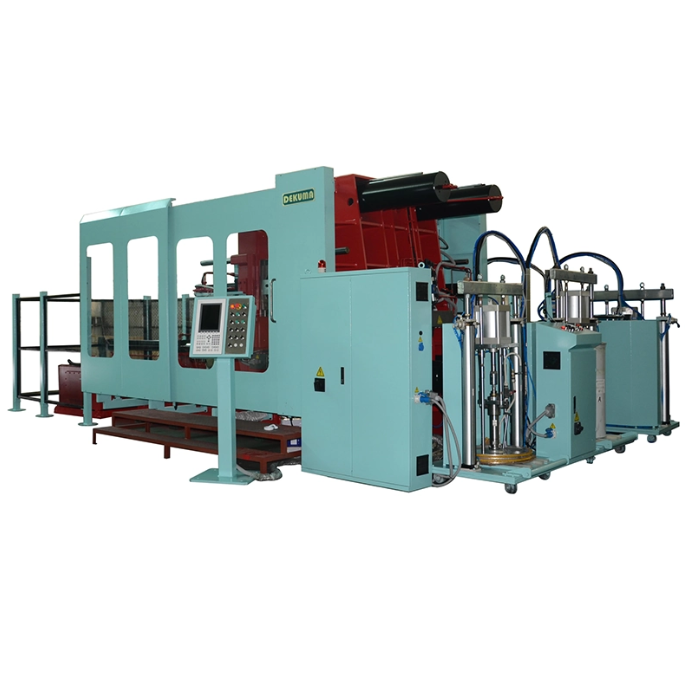
A liquid silicone rubber injection molding machine from Dekuma is designed for liquid silicone rubber products. It uses synchronized dosing and precision mixing technology for A/B material processing. Listed features include the S98 Smart B&R Control System, a patented synchronized dosing system, and an advanced static mixer.
The machine can be applied to electronic components, insulators, arresters, cable accessories, seals, infant care products, food containers, kitchenware, and sports equipment. For these applications, an LSR injection molding machine should be selected with both the A/B dosing requirements and the required shot volume in mind.
Future Production Needs a Usable Operating Window
Future production rarely stays limited to one mold. Automotive, electrical, industrial, and sealing projects may introduce different cavity counts, part sizes, or compounds as orders change. Machine selection should therefore consider the expected product family instead of one current part.
The goal is not to choose the largest injection unit available. Oversizing may add process complexity, while undersizing can restrict mold choices. Injection equipment needs enough operating margin for realistic product changes without creating excessive unused capacity.
Machine planners should also compare the smallest and largest expected shots. This range gives a clearer view of how often the injection unit will operate near either end of its practical capacity.
Dekuma supplies rubber injection molding equipment for sectors including automotive, power, engineering vehicles, agricultural machinery, and military vehicles. In such B2B applications, application-specific equipment planning can help match injection capacity with the actual production task rather than using one standard configuration for very different products.
Planning Capacity Around Real Production
Injection unit sizing will remain important as rubber molding moves toward wider product ranges and more controlled processing. Buyers need to balance shot volume, pressure range, mold demand, material behavior, residence time, and likely future changes.
A rubber injection molding machine should fit the real molding window rather than simply offer a larger nominal capacity. When these factors are reviewed early, production teams can compare equipment more clearly and leave practical room for new molds, new compounds, and changing production requirements.
